THE MOST EXPENSIVE PERSON ON YOUR LOADING BAY IS THE SECOND ONE
24 de julio de 20266 min read
THE MOST EXPENSIVE PERSON ON YOUR LOADING BAY IS THE SECOND ONE
Why single-operator control is quietly the biggest cost line on a car transporter
There is a moment on every car transporter load that decides whether the job goes well or goes wrong.
The driver is at the control panel. The car is on the deck. The gap between a roof rail and the platform above it is somewhere around three centimetres — but the driver can't see it from where the controls are. So they guess, or they shout to a colleague standing at the back, or they move the deck in tiny increments and walk over to check after each one.
That moment is where damage claims come from. It is also where the twenty minutes go.
THE COST NOBODY PUTS ON THE INVOICE
Ask a fleet manager what a car transporter costs and you'll get a purchase price. Ask what a loading operation costs and the answer gets vague, because the real costs hide in places accounting doesn't tag:
A second person on the ground. Not always a full salary — sometimes it's the yard hand pulled off another task, sometimes it's a driver waiting for a colleague to be free. It's still labour, and it's still time nobody billed for.
Cycle time. Six vehicles, three decks, and a control position you have to keep walking back to. Five extra minutes per vehicle is half an hour per load. Across a fleet, across a year, that is real capacity.
Damage. This is the big one. A scuffed alloy on a demonstrator, a creased tailgate on a customer's SUV, a scraped front splitter on a sports car — these are four-figure conversations, and they arrive with a reputation cost attached. Most of them happen during loading, not during transport.
Driver retention. Awkward, stressful, physically repetitive loading is one of the things drivers complain about and one of the reasons they leave. In a market where experienced car hauling drivers are hard to find, that matters more than it used to.
WHAT "SINGLE-OPERATOR" ACTUALLY HAS TO MEAN
A lot of trailers claim one-person operation. The claim only holds if one person can genuinely do the whole job without compromising on visibility or safety.
That requires three things working together.
1. The controls have to come to the operator, not the other way round.
A wireless remote — in this case a Tele-Radio unit — means the driver stands wherever the clearance is tightest and moves the deck from there. They are watching the actual gap, in real time, with their own eyes, while their thumb is on the control. Not remembering the gap from thirty seconds ago. Not trusting a shouted instruction across a noisy yard.
This sounds like a small ergonomic detail. It is the single biggest change in how loading feels.
2. The trailer has to tell you what it's doing.
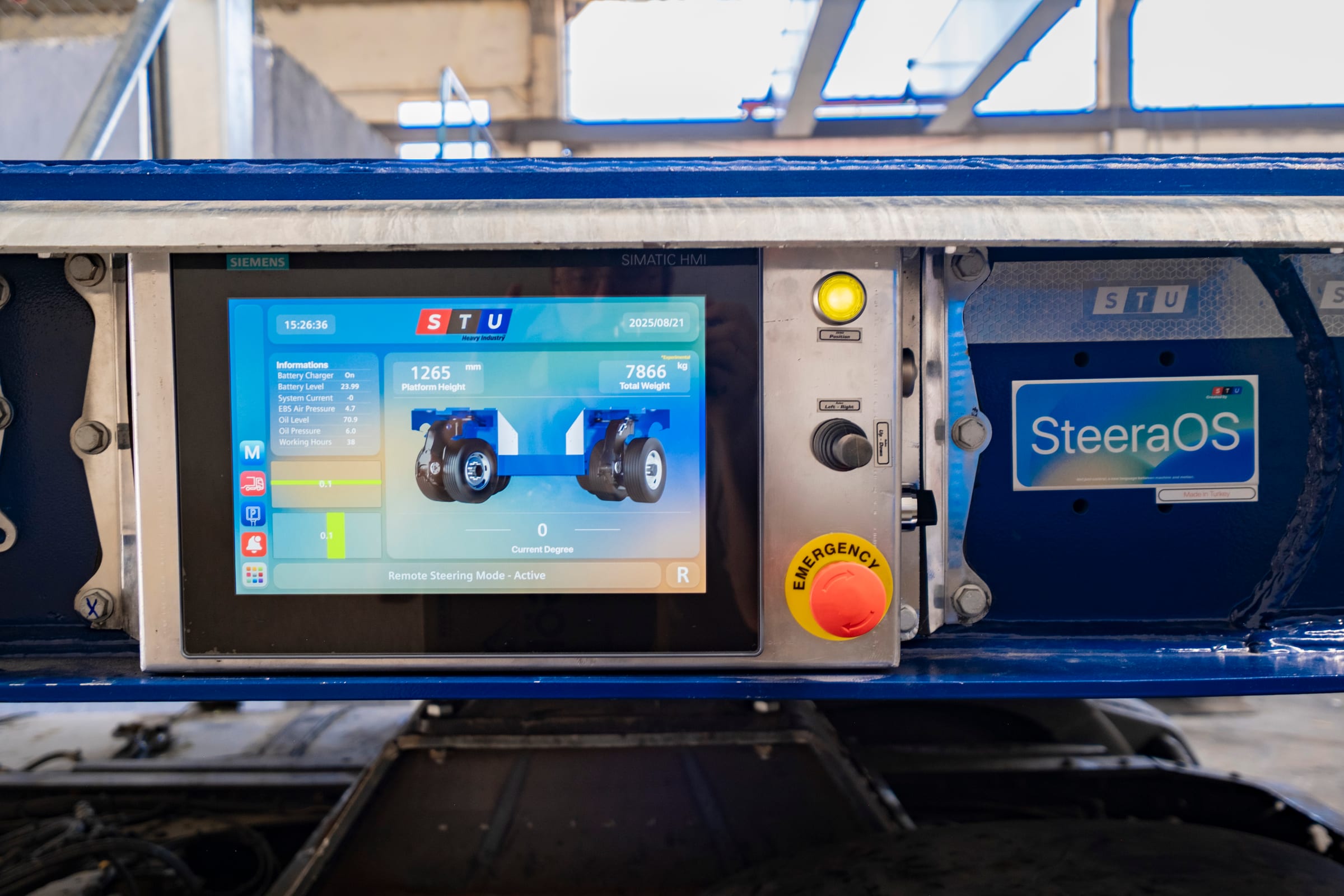
Manual hydraulics give you position and nothing else. A PLC-controlled system with a 7-inch Siemens touch display gives real-time process monitoring — what is moving, where it is in its travel, and whether anything is out of range.
Two sensors on the first platform report maximum and minimum positions, so the system knows the limits of its own travel rather than relying on the operator to know them. That is the difference between a machine you supervise and a machine you have to remember for.
3. Safety cannot depend on somebody not being tired.
Every manual step in a loading sequence is a step that can be skipped at 6 a.m. in the rain at the end of a long shift. The honest way to design for safety is to remove the steps rather than to write them in a manual and hope.
A dual-safety hydraulic valve architecture — replacing mechanically locked cylinders — does exactly that. Fewer manual actions per deck cycle, fewer things to forget, and platform position held reliably rather than held conditionally.
THE PRACTICAL TRANSLATION
Put those three together and a load looks different.
The driver brings the car on. They walk alongside it, remote in hand, standing where they can see the tightest clearance. The deck moves at their pace, in the increments they choose, while they watch. The display confirms position. The safety architecture holds it there without a second set of manual locks.
Nobody shouts. Nobody guesses. Nobody walks back and forth to a fixed control panel. And nobody else has to be standing there.
That is what single-operator loading is supposed to mean.
THE ARGUMENT THAT MATTERS TO THE PERSON SIGNING OFF
Labour saving is the obvious pitch, and it's real. But it isn't usually the number that justifies the specification.
The number that justifies it is damage. One avoided claim on a premium vehicle can outweigh a year of the labour argument. And damage during loading is overwhelmingly a visibility problem — the operator could not see what they were about to do at the moment they did it.
Fix the visibility and you fix the claim rate. The remote is the visibility fix. Everything else is supporting structure.
There is a second-order benefit that rarely makes the business case and probably should: consistency. A loading process that doesn't depend on two people coordinating is a process that runs the same way whether it's your best driver or your newest one, on a bright afternoon or a wet November night. Predictability is worth money in a business where the product is delivering things undamaged, on time, repeatedly.
WHAT TO ASK WHEN YOU'RE SPECIFYING
If you're evaluating car transporters, these are the questions that separate a genuine single-operator design from a claim:
• Can the operator move every deck from anywhere around the trailer, or only from a fixed panel?
• Does the system report platform position back to the operator, or only to itself?
• How many manual steps are there per deck cycle — and what happens if one is missed?
• Can a driver be trained on the control interface in an afternoon?
• When something needs servicing, can you reach the powerpack, filters, and PLC without uncoupling?
The answers tell you more about your future operating costs than the headline capacity figure does.
STU TRAILERS car transporters are PLC-controlled with Tele-Radio wireless remotes, a 7-inch Siemens touch display, and dual-safety hydraulic valve architecture as standard — engineered so one operator can load six vehicles confidently, calmly, and without a second pair of hands.
Talk to us about your fleet requirements: request a quote at stutrailer.com/support, email sales@stutrailer.com, or message +90 541 336 63 77.