All Stock Listings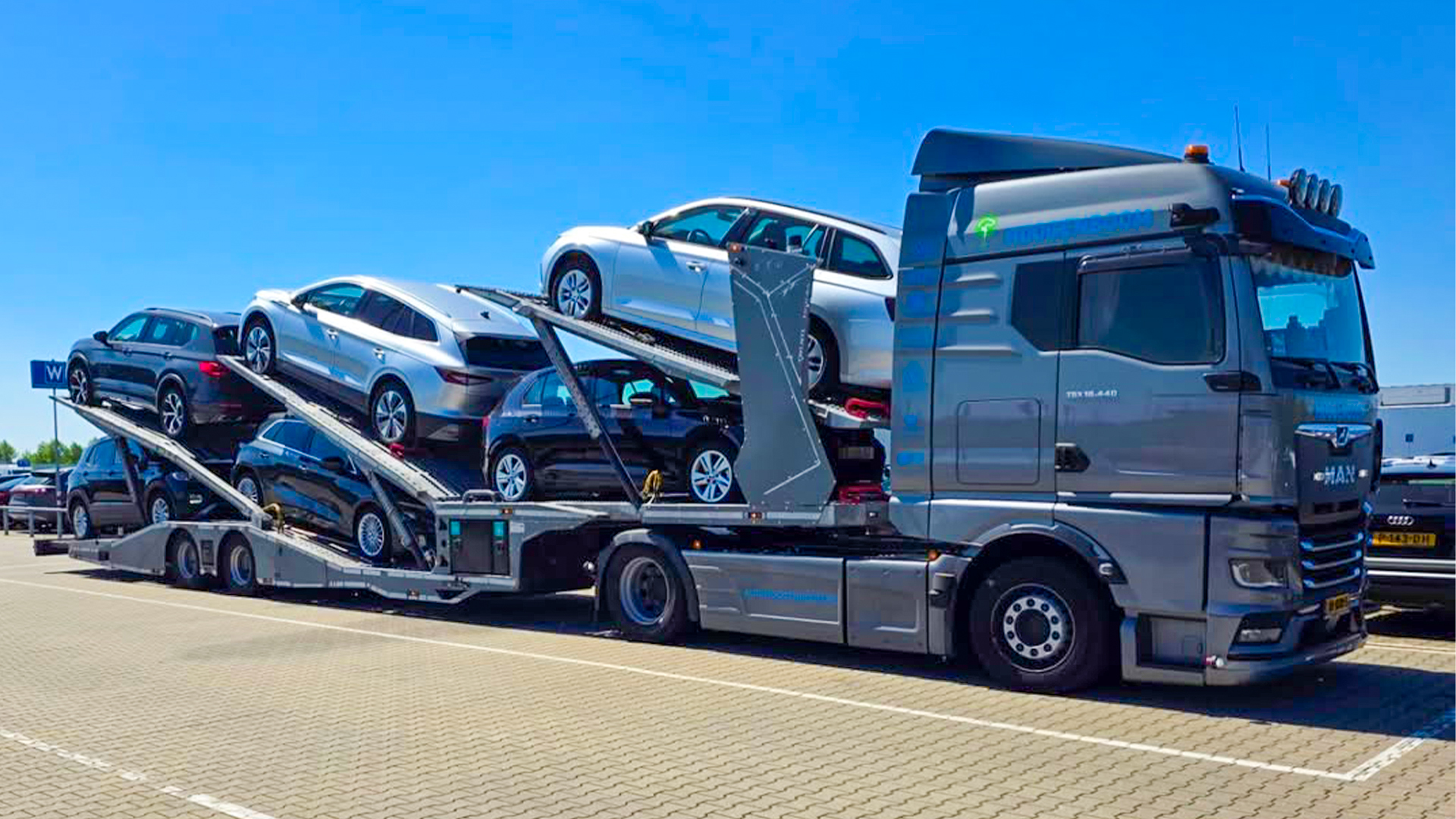
demo
Car Transporter (6 car load capacity)
A deliberate evolution of seamless transport. Efficiency, performance, and reliability—refined into one calm, precise loading experience. From low-clearance sports cars to executive EVs and SUVs, every deck move feels predictable, smooth, and confident and now working on Europe roads.
Price
Price on request
Category
Car Transporter
Year
2026
Location
Europe
About
SIX CARS, ONE TRAILER, ZERO DRAMA: INSIDE THE NEW STU 6 CAR TRANSPORTER
Ask any car hauling operator what actually costs them money, and almost nobody says "steel." They say the twenty minutes lost on a tight loading yard. The scratched bumper on a customer's Taycan. The morning a hydraulic fitting weeps oil onto a dealership forecourt. The driver who needs a second pair of hands to get a low-clearance sports car onto deck three.
That's the problem the STU TRAILERS 2-axle 6 car transporter was built around — not just carrying six vehicles, but carrying them predictably, day after day, with one operator and no surprises.
WHY "SIX CARS" IS THE SWEET SPOT IN EUROPEAN VEHICLE LOGISTICS
Vehicle logistics in Europe has shifted. Cars are heavier — a mid-size electric SUV can weigh what a full-size luxury saloon did a decade ago. They are also more varied: on a single run you might load a family hatchback, an executive EV, a heavy SUV, and a sports car with 90 mm of ground clearance.
A rigid six-slot layout can't absorb that mix. What works is a three-deck architecture where every platform moves independently, so the trailer adapts to the load rather than the load being forced into the trailer. That is the core design idea here: 32,000 kg technically permissible maximum laden mass, with 4,000 kg of independent lifting capacity on each platform.
THREE DECKS, THREE DIFFERENT JOBS
Deck 1 — the gooseneck platform. Height-adjustable, driven by two hydraulic cylinders and supported by worm-screw spindle mechanisms integrated directly into the gooseneck. The spindles matter: they carry the load mechanically rather than relying on hydraulic pressure alone, which is what keeps the platform feeling planted instead of floaty during positioning.
Deck 2 — articulated with length extension. Two cylinders plus an articulated linkage to the main chassis, with an extension for loading flexibility. This is the deck that solves awkward combinations — long wheelbase up top, short car underneath.
Deck 3 — extendable for oversized loads. Same articulated principle, with an extension system for longer vehicles. Paired with a 1,500 mm hydraulic rear bumper and manually extendable aluminium inner ramps, it gives you the shallow approach angle that a Ferrari, McLaren, or a lowered GT car needs to get on board without a scraped splitter.
Add two 4-tonne hydraulic winches with steel rope, integrated safety valves, and emergency stops, and non-runners stop being a scheduling problem.
THE HYDRAULICS WERE REBUILT, NOT TWEAKED
The most meaningful change in this generation isn't visible from the outside.
Mechanically locked cylinders have been replaced with a dual-safety hydraulic valve architecture. Fewer manual steps per deck cycle, fewer opportunities for a tired driver at 6 a.m. to skip one, and higher reliability across a shift.
Around that sit three component upgrades chosen for real-world behaviour rather than spec-sheet decoration:
• Walvoil fully electronic valves (replacing GMS) — smoother, quieter, more responsive platform movement
• Hansa-Flex fittings (replacing Rekorsan) — secure sealing under vibration, temperature swings, and pressure cycling
• Aspöck LED lighting suite — dynamic rear stop lamps, high-visibility side markers, and six working lights for night loading
Power comes from a Bucher 4.3 kW unit with a 70-litre tank, an electronic oil-level sensor to prevent dry running, and a 210 bar operating pressure.
CONTROL THAT FITS ONE OPERATOR
The trailer is PLC-controlled, with a Tele-Radio wireless remote and a 7-inch Siemens touch display giving real-time process monitoring. Two sensors on the first platform report maximum and minimum positions.
The practical translation: the driver walks the vehicle, watches the clearance with their own eyes, and moves the deck from wherever they are standing — rather than committing to a movement they can't see the end of. Single-operator loading isn't just a labour saving. It's usually a damage saving too.
BUILT TO STILL BE WORKING IN TWENTY YEARS
The chassis is S355J2+N high-strength steel, with Strenx 700E available as an option for up to 30% weight reduction — a meaningful trade when payload and fuel are the metrics your business is judged on.
Everything is 100% hot-dip galvanized. Not painted, not part-galvanized. Full-chassis dipping to ISO 1461 / EN ISO 1461 / ASTM A123, delivering 25+ years of corrosion protection. Anyone who has run trailers through Northern European winters and road salt knows exactly what that line is worth on the resale sheet.
Running gear follows the same logic: two 10-tonne Gigant drum axles on air suspension, Wabco or Knorr-Bremse 2S-2M EBS with automatic slack adjusters, an 80 L + 80 L + 1 L air reservoir configuration, and OMS telescopic dual-speed landing legs rated 50 t static / 25 t dynamic. The king pin is an OMS 2" DIN 74080 / SAE unit, detachable 8-bolt type — because serviceability is a design decision, not an afterthought.
MAINTENANCE YOU MOSTLY DON'T HAVE TO THINK ABOUT
Grease guns are a recurring cost and a recurring forgotten task. This trailer largely removes them:
• IGUS TX1 fibre bushings in the articulated joints for grease-free operation
• Polyamide slide sheets under the platform extensions
• Bearings sourced exclusively from German and Japanese manufacturers
• Side-sliding power unit covers giving access to the oil tank, filters, powerpack, PLC, and hubs — even with the tractor still coupled
Less time on the ramp, more time on the road.
CERTIFIED, AND ALREADY WORKING
The design carries VDI 2700 certification, the German standard body of guidance for cargo securing — the benchmark most serious European operators and their insurers look for.
And it's not theoretical. STU 6 car transporters are already running Netherlands to Spain, UK to Italy, Denmark to Belgium, Luxembourg to Austria, and Netherlands to Switzerland, carrying cars, vans, and caravans across the continent.
SPECIFY IT YOUR WAY
No two fleets load the same way, so the configuration list is deliberately open:
Loading and access — aluminium inner ramps, hydraulic rear bumper, height-adjustable hydraulic/manual/air ramps, double-axis hydraulic ramps, detachable aluminium ramps, gooseneck extension
Control and safety — Tele-Radio remote, PLC unit with 7" Siemens touch display, dual-safety hydraulic valves
Running gear — Gigant, SAF, BPW or TRAX axles; Wabco or Knorr-Bremse EBS; Strenx 700E for lighter tare
Included as standard: six steel toolboxes, 26 metal tyre stoppers, eight lashing rings, a sliding spare tyre box, document box, central control panel, emergency brake system, and a detachable cable roller for electric vehicles.
WHO IT'S FOR
Dealership delivery fleets. Manufacturer distribution networks. Vehicle auction transport. Fleet relocation operators. Motorsport and classic car logistics. Anyone moving EVs where battery weight and careful handling are non-negotiable.
If your business is measured in vehicles delivered undamaged per week, the trailer underneath them is not a commodity purchase.
Transparent pricing, no hidden costs, and configurations built to your specification.
Talk to STU TRAILERS about your fleet requirements — request a quote at stutrailer.com/support, email sales@stutrailer.com, or message +90 541 336 63 77.
STU TRAILERS — Fevziçakmak, 10664. Sk. No:30/1, 42050 Karatay/Konya, Türkiye. Trusted seller on Autoline since 2020.